Hungarian Commemoration
Fenix in Focus
Seventy years after the Hungarian Revolution, we celebrate freedom.
Commemorate Hungarian history together
In November, Fenix in Focus reflects on the Hungarian Revolution and the arrival of Hungarian refugees in the Netherlands. A peaceful demonstration in October 1956 grew into a nationwide revolution against the communist regime. The Soviet Union crushed the revolution with military force. On 14 November 1956, the first train carrying Hungarian refugees arrived in the Netherlands.
Exactly seventy years later, we commemorate this history on Plein and celebrate freedom. Stories of migration, identity and building a new life come together through conversations, creative activities, music and dance. Hear from Hungarians who fled to the Netherlands and from the second generation, and discover how the past continues to shape lives today.

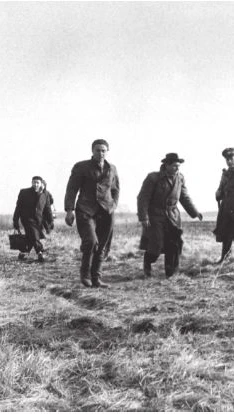
Image: Ata Kandó (Hungary, 1913 – Netherlands, 2017). Austrian-Hungarian border, 1956.
Programme on Plein
Throughout the day, Plein offers space to eat, talk, play and create together. Taste Hungarian classics such as goulash soup, Dobos cake and lángos, play a game of chess or join in with folk dancing and crafts.
The programme is free to attend, with activities for all ages.
Talks and panel discussions
12.30–1.00 p.m. | Talk: Hungarian refugees through the lens of Ata Kandó (Dutch–Hungarian)
Fenix recently acquired a series of original prints by Hungarian-Dutch photographer Ata Kandó (1913–2017). In 1956, she photographed Hungarians who left their country after the Hungarian Uprising was crushed. Réka Deuten-Makkai talks about Kandó’s work and this remarkable series.
1.45–2.30 p.m. | Panel discussion: the second generation (Dutch)
Hear from people born in the Netherlands to Hungarians who fled here in 1956. How does their parents’ history continue to shape their own lives? Writer Patrick Bernhart leads the conversation in Dutch.
2.45–3.30 p.m. | Panel discussion: the first generation (Hungarian)
Hungarians who fled to the Netherlands in 1956 share their memories and experiences. Zsuzsa Nagy leads the conversation in Hungarian.
Hungarians fleeing in All Directions
In All Directions, see a newly acquired series of photographs by Ata Kandó, taken in 1956 after the Hungarian Uprising began. Thousands of Hungarians lost their lives during the uprising and more than 200,000 people fled the country, many of them to Austria.
Kandó spent ten days in the border region, photographing young children with suitcases, families walking through the mud and a tractor crowded with people who had fled. Rather than focusing on the violence in the cities, she turned her camera to its consequences and sought to give Hungarian refugees a face. The photographs are original prints made by Kandó herself in 1956.

Visit the exhibition
Curious to see more art and stories about identity, displacement and home? Visit All Directions featuring art by more than one hundred artists from around the world.
About the partners
Patrick Bernhart has written, among other works, a biography of Boris Johnson, a company history of KPN and Vlieg, mijn zwaluw, a book about his Hungarian family history.
The Hungarian Cultural Foundation Mikes Kelemen has been preserving, sharing and promoting Hungarian culture in the Netherlands since 1951.
Stichting StiHon supports Hungarian children, young people and families in the Netherlands and Western Europe through education, cultural activities and opportunities to meet.
This programme is a collaboration with the Hungarian Cultural Foundation Mikes Kelemen, Stichting StiHon and writer Patrick Bernhart, the son of Hungarian refugees. It is made possible with financial support from the Municipality of Rotterdam and the Gilles Hondius Foundation.